In Trabzon the need for a tow truck usually arrives without warning: a breakdown on the D010, an engine that will not turn over on the Maçka road, a tyre at the Of exit, a flat battery at night in Meydan. In a moment of panic, the right order of steps matters. On the Trabzon Çekicim line the goal is clear: get your location, quote a fixed price upfront, send the team out. The fastest route is to send a location pin on WhatsApp or to call 0462 606 06 21. In this article we explain step by step what to do from the first call to the drop-off, which pieces of information affect the price, and the mistakes people make most often.
The first 60 seconds: safety first, then the call
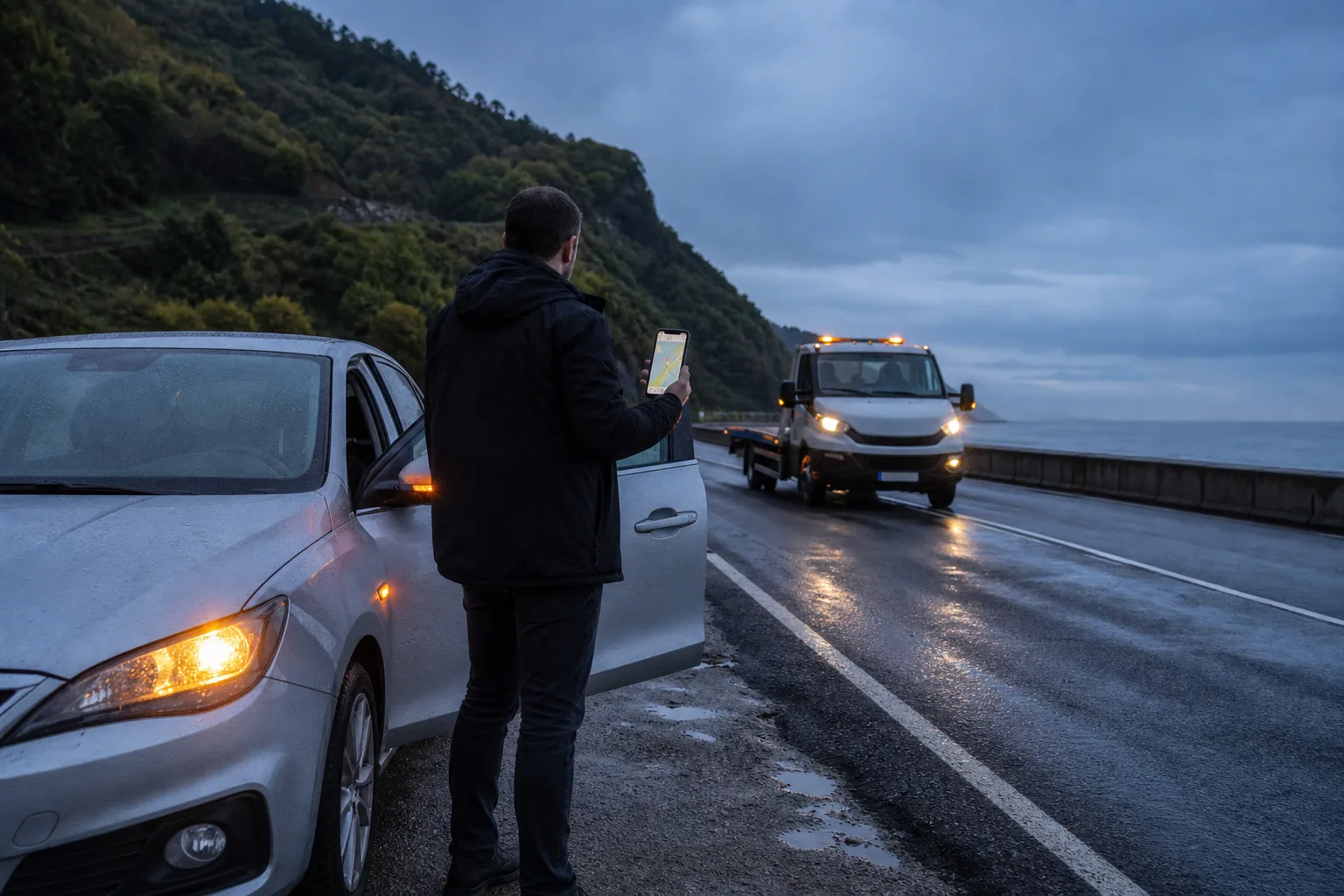
If your car will not move, personal and traffic safety come first. Put the hazard lights on and, if you can, pull over to the central reservation, a wide lay-by or the kerb. If you are stuck in a live lane, use your high-visibility vest and warning triangle; if you suspect injury or fire, call 112. As soon as you have reached a safe spot, call the tow truck — on the D010, at the coastal junctions and on narrow district roads in particular, a blocked lane builds a queue very quickly. Calling early protects both you and the traffic coming up behind you.
Writing a long set of directions instead of sharing your location wastes time. Dropping a pin on WhatsApp is far clearer than saying “we are somewhere in Akçaabat”. If you cannot send a pin, write the name of a specific junction, mosque, school or kilometre marker. Arrival times differ between the coastal strip and the inland districts of Trabzon; an accurate pin speeds up sending the right team.
WhatsApp or a phone call?
Both reach the same line: 0462 606 06 21. WhatsApp is handy for a location pin, photos (a flat tyre, damage, a view of the plate) and a written record. If the traffic is heavy, it is raining or visibility is poor at night, calling works just as well; the operator will give you the estimated arrival time and the fixed price upfront in the same conversation. After you send a message, wait for the reply; the trio of location, vehicle type and drop-off address settles most call-outs in one round.
What you must tell us when you call
Three pieces of information are enough: where the car will be picked up (a pin or clear directions), the vehicle type (car, SUV, van, motorcycle, light commercial) and where it will be taken (authorised dealer, independent garage, home, car park). Short notes such as “automatic gearbox”, “electric”, “the steering is locked”, “flat tyre” or “bonnet damage” also make choosing the right team easier. Without this information a price estimate stays vague; a fixed price upfront needs clear points at both ends.
Things we are often asked but do not need
The registration plate, policy number or garage appointment time are not required in the first minute; we will ask for them later for the invoice or the handover. There is no need to haggle over “how many kilometres is it?” — at Trabzon Çekicim the price is agreed upfront based on the pick-up and drop-off points, and it is settled before we set off. Nobody asks about a night or public holiday surcharge; the same tariff applies 24/7.
How is the fixed price upfront worked out?
The price is determined by distance, vehicle type and loading conditions. A short transfer within Ortahisar and a run on the Uzungöl–Of or Zigana route will not come to the same figure; that is why the pin and the delivery address matter. The figure we agree on is the figure that stands: no extra lines appear afterwards for “there was traffic” or “it was night-time”. If your insurance policy covers roadside assistance or towing, we will issue an invoice; passing the paperwork to the insurer is up to you. Just mention that you want an invoice when you call.
For intercity jobs (Giresun, Rize, Gümüşhane and other routes) the same logic applies: the pick-up point, the drop-off point and the vehicle type are agreed upfront. There is no “we will see later” approach; the figure is settled before we set off. You can look at our intercity pages for detailed routes.
Make these clear during the price conversation
Are the pick-up and drop-off points in the same place, or is the car going to another district? Is it a car, an SUV or a van? Is there anything that makes loading harder (locked steering, a steep road, a narrow street)? The answers to those three questions lock in the fixed price upfront. We would rather not quote “something average” on the basis of vague directions; a clear point and a clear figure is the more honest way to work.
What changes from area to area in Trabzon?
On the coastal D010 strip (Ortahisar, Akçaabat, Yomra, Arsin, Araklı, Sürmene, Of, Vakfıkebir, Beşikdüzü, Çarşıbaşı) traffic density affects the arrival time; in the inland and high districts (Maçka, Çaykara, Düzköy, Tonya, Hayrat, Köprübaşı, Dernekpazarı, Şalpazarı) fog, ice, tight bends and road conditions come to the fore. We share the weather and the state of the road honestly on the phone; no weather surcharge is added to the agreed price. We go out to all 18 districts on the same 24/7 line.
Can it be fixed on the spot?
On every call-out we try an on-the-spot fix first. If the engine will not turn over we can jump-start the battery; if you have a flat tyre and a spare, we can fit it where possible. If that is not an option, we plan a transfer by flatbed tow truck to a garage or to your address. Motorcycles and scooters are carried upright with straps rather than laid on their side. Saying “battery only” or “I have a spare tyre” on the call prevents an unnecessary team being sent.
Night, rain and heavy traffic
In Trabzon, rain at night and coastal traffic often arrive together. When visibility drops, a location pin becomes even more critical; saying “we are somewhere around here” can send the team to the wrong junction. A pin plus a quick photo (a road sign, a junction) on WhatsApp shortens the arrival time. The fixed price upfront applies to night call-outs too; there is no separate night tariff.
What happens once the team arrives?
The team first chooses a safe loading point, brings the car onto the flatbed under control and secures it with straps. Stay with us if you can, and confirm the last details such as the garage address or the gate code for the car park. At the other end the car is unloaded safely. If you asked for an invoice, the paperwork is handed over then or sent afterwards. The timing varies with the location and the state of the roads; the estimate given on the call is a reference point.
Common mistakes
A long conversation without giving a location, the wrong garage address, not saying what type of vehicle it is and saying “come out and we will talk later” all stretch the process out. Negotiating with another tow company at the same time and sending out two teams also creates confusion in traffic. One clear call, a price upfront and one team is the cleanest route. With damaged cars or after an accident, do not say “just drag it”; controlled, safe loading protects both your car and your insurance claim.
Misleading “cheap” offers
Steer clear of the approach where someone quotes a low figure on the phone without asking for exact points and then says “actually it was a long way”. At Trabzon Çekicim the figure is settled upfront before we set off. If you are in any doubt, confirm the pick-up and drop-off addresses once more; a written WhatsApp record is useful too.